
About us
Toff and Kiddy Hill, Kasane
A small, privately owned safari company. We have guided Botswana and its neighbours since 1994.
Who you travel with
One of us comes with you
Between us we handle the planning, the quoting and the answering of email, and then one of us is on the safari itself. That is deliberate, and it is the part guests tell us they notice.
Ask whether the Khwai crossing will be passable in April and the answer comes from someone who was there last April, not from a booking desk reading a brochure. Our number is on the contact page rather than a switchboard, and we would rather you used it before you commit to a fortnight in a vehicle.
Safaris start in Kasane, on the Chobe River, because that is where you will land and where the wildlife country begins. We ourselves live out in Chobe District rather than in town, which is less convenient for us and considerably better for the guiding.
Out in the field it is a team. Toff or Kiddy travelling with you, an experienced professional guide, and our own camp staff looking after the cooking, the camp and the packing up. Nobody is doubling as the driver, the cook and the guide at once, which is what keeps the standard up on a long trip and means somebody always has time to answer your questions.
That is what makes the guiding local rather than researched. We know which waterholes are producing this month, which tracks turn to soup after a storm, and which camps are worth the extra two hours of driving. None of it can be looked up.
We have been at it since 1994, which is long enough to have learned that the best safari is rarely the busiest one. The company itself has been registered in Botswana since 1995 and has traded under the same two owners ever since, which in this industry is less common than it ought to be.

A day in camp
How the days actually run
No two are identical, and that is rather the point, but the shape of a camping day looks like this.
- Before sunrise
Coffee, then out
The fire is lit early and there is coffee before the sun is properly up. We head out while the air is still cool, which is when the cats are moving and the birds are loudest.
- Mid-morning
Brunch back in camp
Your camp crew has breakfast or brunch ready when we get back. Bacon over a fire tastes better than it has any right to.
- The heat of the day
Nothing much, deliberately
Shade, a book, a bucket shower, and whatever wanders past camp. Hornbills and squirrels will investigate your lunch. In green season this is often when the rain arrives, and watching a Kalahari storm cross the pans from under canvas is worth the trip on its own.
- Late afternoon
Out again until the light goes
The second outing runs into the evening. We stop somewhere with a view as the sun drops, then drive back with a spotlight and see what the night shift is doing.
- After dark
Dinner, fire, and the night sounds
Dinner is cooked in camp and eaten under the stars. After that it is the fire, the conversation and whatever is calling out in the dark. At Xakanaxa the spotted hyena often walk past camp; on the Chobe you hear elephant well before you see them.
You can be as involved as you like. Some guests want to help pitch camp and stir the pot, others want to sit down with a cold drink and let the crew work. Both are completely normal, and nobody minds which you choose.
Sleeping arrangements
Canvas, a lodge, or a bit of both
We are camping specialists first, but the trip is yours, and plenty of guests split the difference.
What camping means here
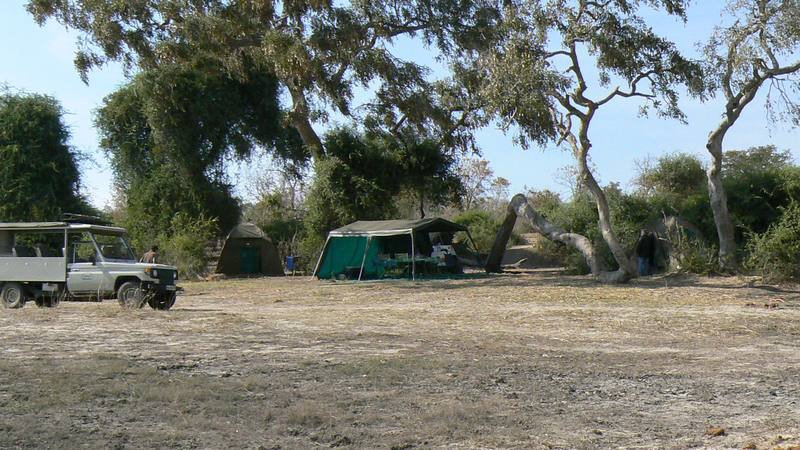
A spacious dome tent you can stand up in, a bedding bag with a proper mattress, bed linen and a pillow. Not a bedroll on the ground. Camp is pitched before you arrive and struck after you leave.
Meals, tea, coffee and soft drinks come with the mobile safari, and there is wine with dinner on most itineraries.
What to bring
One soft hold-all, kept light, because charter flights into the Delta allow 20 kg per person. A small day pack for what you want beside you in the vehicle. Your own binoculars, which beat a borrowed pair every time.
Luggage travels in a heavy-duty off-road trailer or on the vehicle. The travel notes cover the rest.
If canvas is not for you
We use lodges throughout the wildlife regions, with hot showers, cold drinks and someone else making the beds. A common pattern is canvas in the parks where the game is and a lodge in between to catch up on sleep and laundry.
Fly-in and fly-out legs are available where time is short.

Guides and vehicles
Thorough, factual, and still good fun
You travel with one of our professional guides throughout. At all times there will be a thorough and factual approach to nature, animals and our feathered friends, and it is meant to be enjoyable as well as informative. A guide who cannot tell you why the mopane leaves fold in the heat is only half doing the job.
Birding is guided properly rather than treated as an add-on, which matters when you are trying to separate a Bleating Warbler from the wind in the reeds.
Our vehicles are tough and purpose-built for these conditions. Once on safari the ‘roads’ are sand, dust and mud rather than tarmac, which is exactly why the evening shower feels as good as it does.
The country
What you are actually looking at
A safari is more interesting when you know what you are seeing. A little groundwork on Botswana before you come, and we will fill in the rest around the fire.
The trees
Mopane, baobab, marula, acacia, camel thorn, motopi (the shepherd’s tree), wild date palm, papyrus, sycamore fig, real fan palm, African mangosteen and the sausage tree. They cluster where the water is, which is why the Okavango swamps are so densely wooded and the Kalahari is not.
The people
The official language is English and the national language is Setswana. You will also hear Sindebele, Kalanga, Kgalagadi, Afrikaans and several Bushman dialects. English is the language of tourism, so you will be understood everywhere you go with us.
The wildlife
Nothing rivals an elephant plastered ghostly white in Kalahari dust, emerging from the heat haze at Nxai Pan, or the play of golden light on springbok skittering off into the desert. Finding one gemsbok alone in an empty stretch of Kalahari is more rewarding than an easy lion in a game-rich area, and we would rather show you the former.
The birds
Some 550 species are recorded on Botswana’s national list, including rare vagrants that turn up now and again. The wet season is the time to come, once the migrants have arrived. Our birding page goes habitat by habitat.

Start the conversation
Tell us what you want to see
Tell us when you would like to travel, how long you have and what you most want to see. You will hear back from Toff or Kiddy personally, not by a call centre.